A list of CVEs in your dependencies is easy to get. Every scanner gives you one. The list is not the problem. The questions that come after it are:
- Which version fixes this JAR? Not every fixed version of every line of the library, the one for the version I have.
- How did it get onto my classpath? I never declared it.
- Do my routes even use it?
- And what exactly do I change?
Camel 4.24 answers those questions, for Camel integrations. The CVE Audit screen of the Camel TUI got a lot better, and the same audit is now a command, camel dependency audit, for a script, a CI job or an AI agent.
Try it with the example
The new CVE audit example is the shop’s order feed, with outdated libraries on purpose. Its application.properties declares two of them:
# DELIBERATELY OUTDATED: two libraries with known CVEs
camel.jbang.dependencies=org.apache.commons:commons-text:1.9,org.yaml:snakeyaml:1.33
commons-text 1.9 has Text4Shell, CVE-2022-42889, and a small bean uses it to write a note for each order. snakeyaml 1.33 has CVE-2022-1471, and nothing uses it at all. Never copy those versions into a real project, of course. The example has no HTTP endpoint or other input from the outside: the orders come from a timer.
Run the audit in the example’s folder:
$ camel dependency audit
 SEVERITY  SCORE  CVE             ARTIFACT                               FIX     VIA           USED  SUMMARY
 CRITICAL    9.8  CVE-2022-42889  org.apache.commons:commons-text:1.9    1.10.0                      Arbitrary code execution in Apache Commons Text
 HIGH        8.3  CVE-2022-1471   org.yaml:snakeyaml:1.33                2.0                         SnakeYaml Constructor Deserialization Remote Code Executi…
 MEDIUM      6.5  CVE-2025-48924  org.apache.commons:commons-lang3:3.11  3.18.0  commons-text        Apache Commons Lang is vulnerable to Uncontrolled Recursi…

3 vulnerabilities in 3 of 27 dependencies of the project (1 CRITICAL, 1 HIGH, 1 MEDIUM)
Two of them we put there. The third one we did not: commons-lang3 3.11 came along with commons-text 1.9, which the VIA column says.
Which version fixes it
A vulnerability record lists the fixed versions of every line of a library, and sometimes of several libraries at once. “Fixed in 2.12.7.1, 2.13.4, 2.14.0, 2.15.0” does not tell you what to do with 2.13.2. The FIX column does: it is the end of the affected range your version is in, for that artifact only. 2.13.2 gets 2.13.4.
For a Camel JAR, the audit also checks the Apache Camel security advisories that ship with the Camel catalog, which say which Camel release fixes a CVE of a Camel component. camel-salesforce 4.18.1 gets “Camel 4.18.3”: the patch release of your own line, not “upgrade to the latest”. The advisories are checked even when the vulnerability database cannot be reached, and --offline checks only those.
What to upgrade
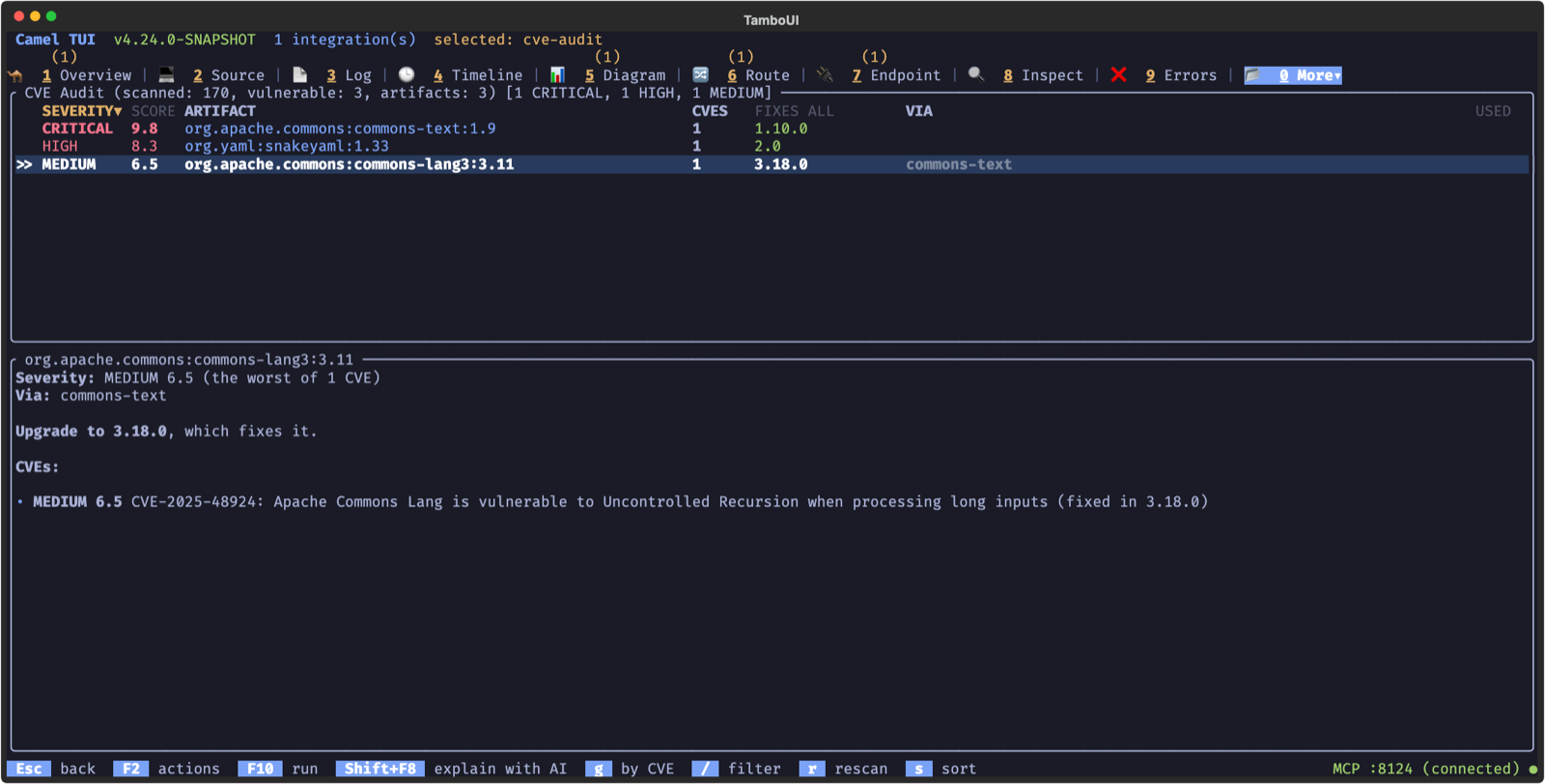
One JAR often has several CVEs, and each has its own fix. --by-artifact turns the table around: one row per JAR, with the version that fixes all of them, which is what you actually change.
$ camel dependency audit --by-artifact
 SEVERITY  SCORE  ARTIFACT                               CVES  FIXES ALL  VIA           USED
 CRITICAL    9.8  org.apache.commons:commons-text:1.9       1  1.10.0
 HIGH        8.3  org.yaml:snakeyaml:1.33                   1  2.0
 MEDIUM      6.5  org.apache.commons:commons-lang3:3.11     1  3.18.0     commons-text
The example has a small lesson here, which we found while writing it. commons-text 1.10.0 fixes Text4Shell, but it still brings commons-lang3 3.12.0, which has the commons-lang3 CVE too. commons-text 1.14.0 is the first to bring a fixed commons-lang3. So the change that fixes all three is commons-text 1.14.0 or later, and no snakeyaml. Upgrade, run the audit again, and see.
How did it get here, and is it used?
VIA is the dependency chain from a dependency of your project to the vulnerable JAR, worked out from the POMs of the JARs on the classpath. The example’s chains are short. In an integration with Kafka they are longer, such as snappy-java 1.1.10.1 coming in with kafka-clients, which camel-kafka brings:
 SEVERITY  SCORE  CVE             ARTIFACT                                FIX       VIA                          USED
 HIGH        7.5  CVE-2023-43642  org.xerial.snappy:snappy-java:1.1.10.1  1.1.10.4  camel-kafka > kafka-clients  yes
USED says whether your routes use the JAR: yes when they have an endpoint of the Camel connector that brings it in (here a kafka: endpoint), no when they have none. A no is the useful one: the library is on the classpath, but no route reaches it, so it is lower on your list. USED is empty when no connector brings the JAR in, as for the libraries the example declares itself.
A yes does not mean you are affected. It means the library is in use, not that its vulnerable part is: the snappy CVE is in decompressing snappy data, so it matters when the Kafka messages are snappy-compressed. That question is a good one for an AI.
In the Camel TUI, with the AI
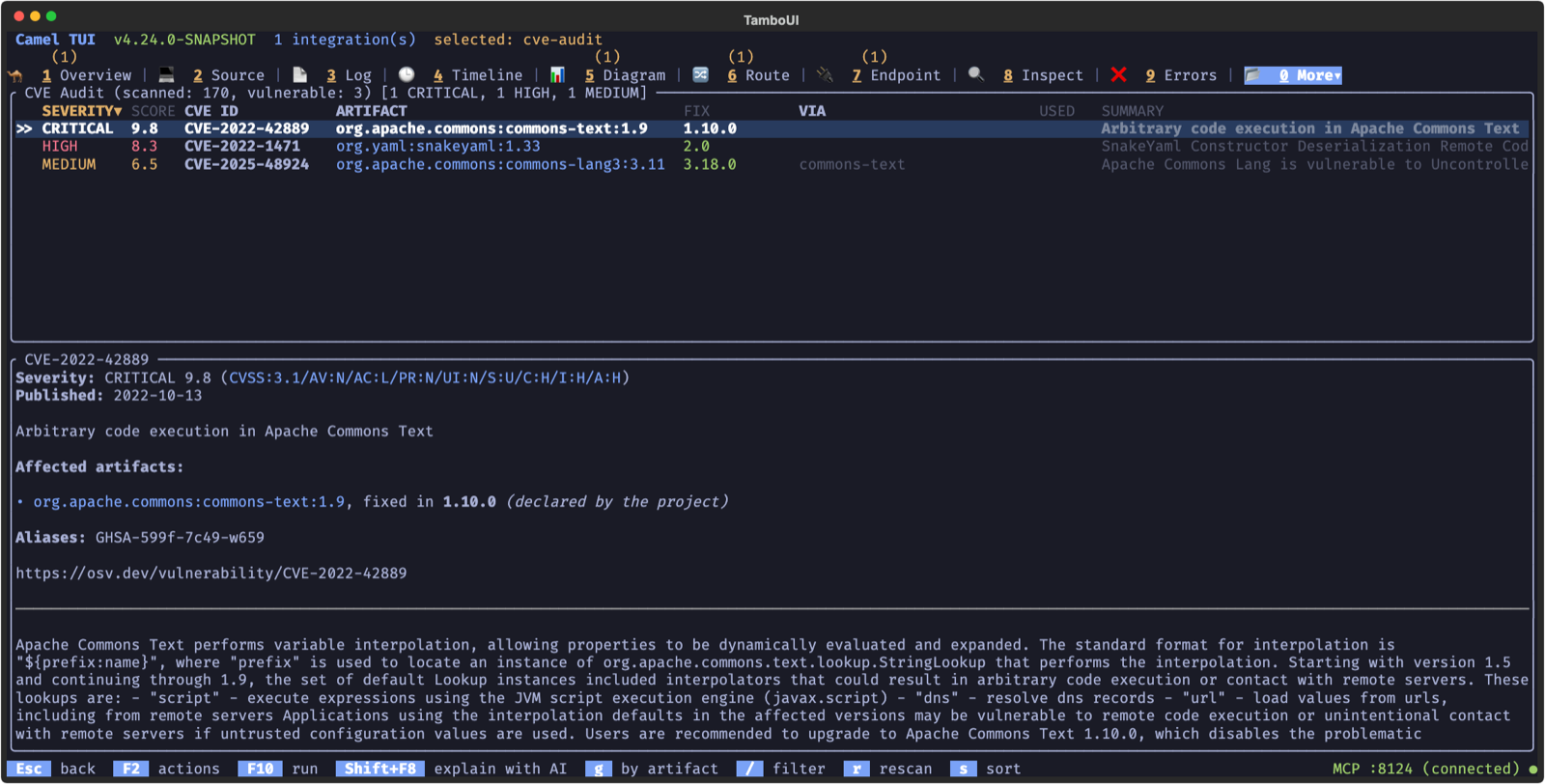
The CVE Audit screen of the TUI (under More > Project) does the same audit on a running integration: the JARs it actually loaded, with the same columns. g groups the table by artifact, / filters it (kafka keeps what camel-kafka brings in), and the detail panel has the full description, the Camel advisory with its mitigation, and the version that fixes each JAR.
Grouped by artifact, commons-lang3 says how it came in, and what to upgrade it to:
Press Shift+F8 on a vulnerability, or on an artifact, and the AI panel opens with a question made of all of that, and the change that fixes it. For a JAR the project declares itself, the suggestion reads like this:
Suggested changes:
- org.apache.commons:commons-text: use org.apache.commons:commons-text:1.10.0 where the project declares it (//DEPS,
  camel.jbang.dependencies or --dep)
The AI is asked whether the integration is affected, from its routes and configuration, and to offer the change. It changes no file unless you agree.
The example is made for this. Text4Shell is about the interpolator of commons-text, with its script, dns and url lookups. The example’s bean uses a StringSubstitutor with a plain map of values, and the values come from a timer. The library is vulnerable, but the integration is not exposed, and upgrading is still the fix. snakeyaml 1.33 is not used at all, so the fix is to remove it. See what your AI makes of it.
In your build
camel dependency audit exits with 1 when it finds a vulnerability, so a CI job fails:
# fail on critical ones only, list high and worse
camel dependency audit --fail-on=critical --severity=high
--fail-on=none never fails, and --json prints one JSON document for a script or an agent. By default it audits the project files, with the dependencies they bring in resolved as Maven does. --integration=<name> audits a running integration instead: the versions it actually loaded.
Found on the way
Writing the example found a gap. camel run downloads the dependencies you declare (camel.jbang.dependencies, //DEPS, --dep) into a class loader of its own, and the JVM classpath, which the TUI read, does not list them. So the CVE Audit screen never saw commons-text or snakeyaml of the example. It does now, and so do the Classpath and Heap Histogram screens.
The example also shows something worth knowing about a declared old version: Camel brings snakeyaml 2.x itself, so the example ends up with both snakeyaml 1.33 and 2.x on the classpath. After a change, look at the Classpath screen to see that only the version you want is left.
Try it
Camel 4.24 is not released yet. If you want to try the audit now, the example runs with a 4.24 snapshot of the Camel CLI. The documentation has the options.
We would love to hear what it finds in your integrations, and what you miss: tell us on the mailing list or Zulip chat, or in Jira.